
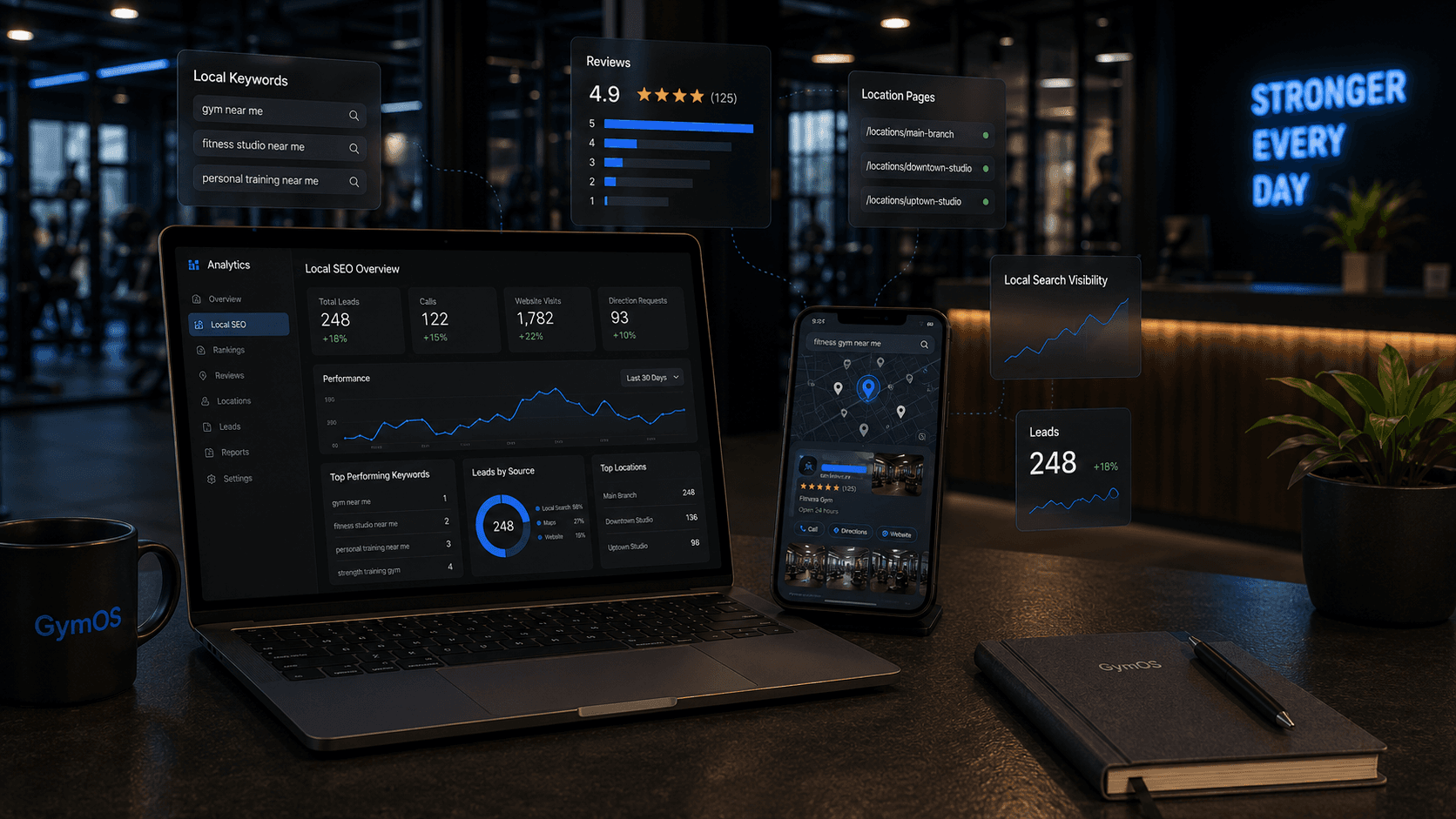
When a potential member searches for a gym on Google, they are usually within a few kilometres of your location and ready to make a decision within days. Local SEO is the process of making sure your gym appears when that search happens — and appears well.
The basics are well understood: claim your Google Business Profile, keep your NAP (name, address, phone) consistent, and collect reviews. But most gyms stop there, which means anyone willing to go further has a significant competitive advantage.
Optimise your Google Business Profile beyond the basics
Your Google Business Profile (GBP) is effectively a free webpage that appears above your website in local search results. Most gyms fill in their name and hours and consider it done. The gyms that rank consistently do more.
- Use the Q&A section actively. Post the most common questions you get from prospective members and answer them yourself. These appear publicly and improve your profile's relevance.
- Add posts to your GBP at least twice a month. These can be offers, events, or news. They signal to Google that your profile is actively managed.
- List every service individually: personal training, group fitness, yoga, nutrition coaching, strength training. Each service you add becomes a searchable attribute.
- Use the "description" field to naturally include your area name and key training types. Avoid keyword stuffing — write for a human reader first.
Build location-specific pages on your website
If you serve a specific neighbourhood, suburb, or city district, you need a page on your website dedicated to that location. A generic "about us" page will not rank for "gym in [neighbourhood name]."
- Create a page titled "[Your Gym Name] — [Neighbourhood]" with content specific to that area.
- Include genuinely local information: nearby landmarks, parking notes, public transport access.
- If you have multiple locations, give each its own dedicated page. Do not try to serve all locations from a single page.
- Add schema markup to each location page to help Google understand it is a physical business at a specific address.
Build a reviews system, not a reviews moment
Most gyms ask for reviews after a positive interaction and then forget about it for six months. Competitors who build a consistent review process will outrank you over time, even with a similar star rating, because Google rewards recency.
- Ask for reviews as part of your member onboarding at the 30-day mark, not on day one. Members who have been with you for a month have something real to say.
- Make it easy: send a direct link to your Google review form, not just a request to "leave a review."
- Respond to every review within 48 hours. Responses are indexed and signal engagement.
- Do not incentivise reviews — this violates Google's terms and can result in your listing being penalised.
Local keywords: go specific, not generic
"Gym" is not a keyword you can realistically rank for. "CrossFit gym in [specific suburb]" is. The more specific your target keywords, the more achievable and valuable your ranking will be — because the person searching for that term knows exactly what they want.
- Use Google's autocomplete and "related searches" to find specific phrases people use in your area.
- Build content around these phrases — not just on your homepage, but across blog posts, service pages, and your GBP.
- Local intent keywords ("near me", "[city name]", "[suburb name]") should appear naturally in your meta titles and descriptions, not forced.
Tracking leads from local search
You cannot improve what you cannot measure. Most gyms have no idea how many of their new members found them through Google search.
- Set up Google Search Console and connect it to your website. It shows you exactly which search terms are bringing visitors to your site.
- Ask every new member how they found you, and log the answer in your CRM. Over 50 members this data becomes statistically useful.
- Use UTM parameters on any links you share digitally so you can track which channels are converting.
- If you run a click-to-call button on your GBP, use a tracking number to measure how many calls come from Google.
Local SEO is a slow game that compounds. A gym that invests consistently for twelve months will be almost impossible to displace by a competitor who starts from scratch.