
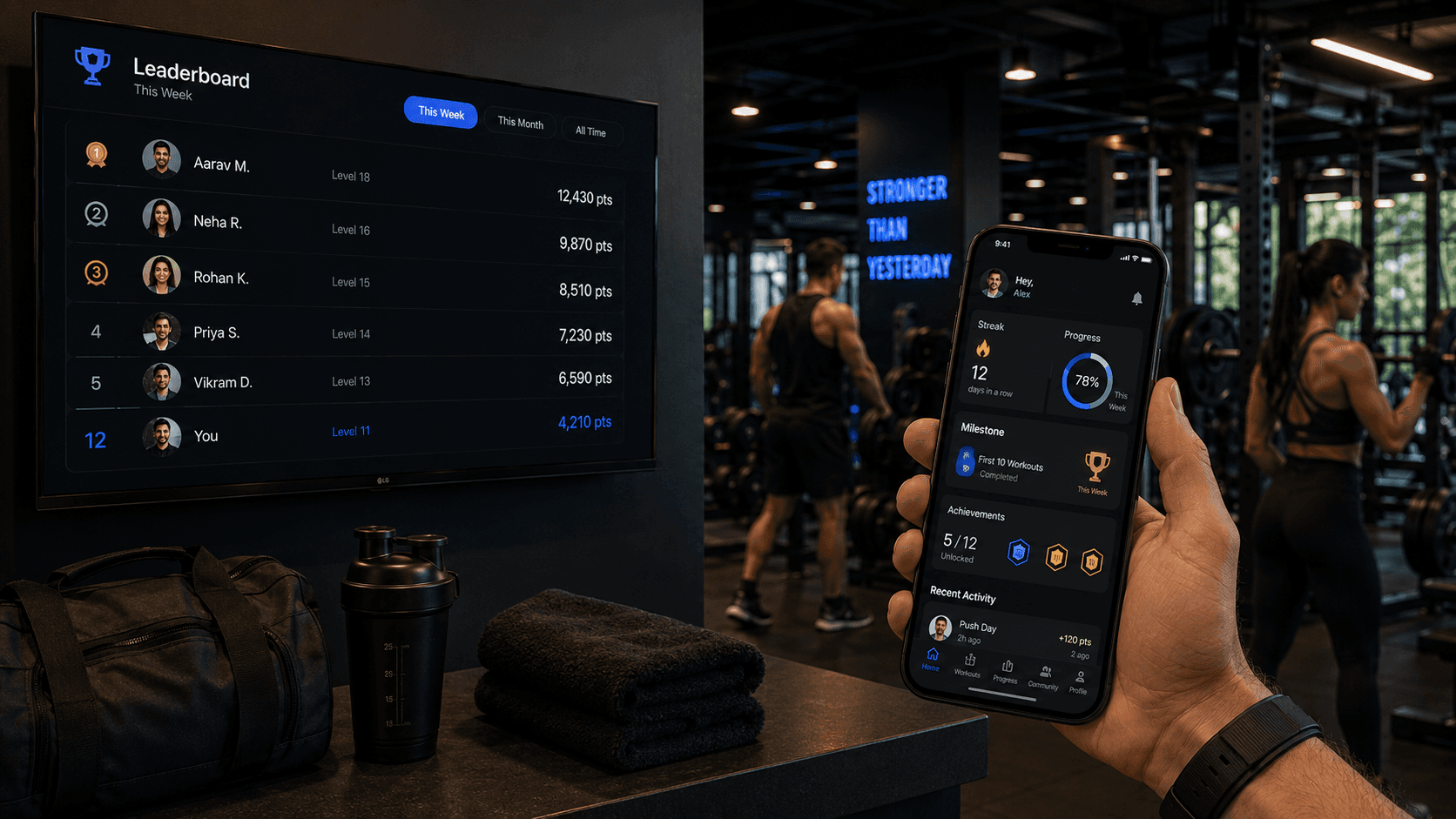
Engagement and retention are related but not the same. A member can be retained — paying every month — but disengaged — rarely showing up. Disengaged members are at high risk of cancelling. The goal is not just to keep members paying, but to keep them active, invested, and part of your gym's community.
Gamification — the use of game-like mechanics in non-game contexts — is one of the most effective tools for doing that. When applied thoughtfully, it makes fitness feel rewarding in ways that go beyond the workout itself.
Why gamification works in a fitness context
Fitness is inherently motivating once someone is in the routine — but getting to the gym consistently is one of the hardest behaviour-change challenges people face. Gamification helps by introducing extrinsic motivation early (visible progress, rankings, recognition) until intrinsic motivation (the actual enjoyment of training) takes over.
- Leaderboards create social accountability. When members know their performance is visible to their peers, they push harder and show up more consistently.
- Streaks and milestones create a "do not break the chain" effect — psychologically, continuing a streak feels more important than starting a new one.
- Rankings make progress visible. A member who has moved from rank 12 to rank 7 on the squat leaderboard has a concrete reason to keep coming back.
- Social features — feeds, comments, reactions — create a sense of belonging. Members who feel connected to a gym community are far less likely to cancel.
Leaderboards: designing them to include, not exclude
A poorly designed leaderboard can backfire. If it only shows the top five lifters, beginners — who are the most at-risk group for cancellation — will feel excluded and stop engaging with it.
- Show each member their own ranking, not just the top of the list. A beginner at rank 47 of 80 can still take satisfaction in being in the top 60%.
- Use relative categories where possible — by age group, experience level, or training phase — so more members have a realistic path to a top-ten position.
- Celebrate improvement, not just position. A member who improved their best squat by 10 kg deserves recognition even if they are not near the top of the list.
- Rotate spotlight categories regularly so different exercises — and therefore different member strengths — get featured.
Progress loops: making every session feel meaningful
A progress loop is a simple cycle: effort → visible result → motivation → more effort. In a gym, the simplest version of this is a workout log. A member who can see their own data — weight lifted, reps completed, progress over time — has a record of their investment. That record becomes a reason to return.
- Set-by-set logging gives members data they can actually use to improve. Seeing that they hit a personal best on bench press is a better motivator than a generic "keep it up" message.
- Historical comparison — "you lifted 5% more this week than last month" — creates automatic milestones without any manual tracking.
- Body metrics logging (weight, body measurements) gives members a second data stream that often moves more visibly than strength progress, especially early in a training journey.
Social accountability: the community effect
The most powerful retention driver in a gym is not the equipment or the programming — it is other people. Members who have friends at a gym are significantly less likely to cancel, because doing so means losing a social connection, not just a fitness service.
- A social feed where members can share progress photos and training updates creates informal accountability without requiring any staff effort.
- Follow and follower systems let members build their own sub-community within the gym, which deepens the social tie.
- Reactions and comments on progress posts replicate the social reinforcement of a group class but persist digitally — a member who receives encouragement from peers at 11pm is more likely to show up in the morning.
Milestones worth celebrating
- 100th gym visit
- First time in the top 10 on any leaderboard
- New personal best on a tracked lift
- Completing a coach-assigned workout plan
- 30-day consecutive attendance streak
These milestones do not need to be complex or expensive to acknowledge. A personalised message from the gym's admin or trainer, visible recognition in the community feed, or a brief shout-out from a coach is often enough. The act of noticing matters more than the reward.
Members who feel seen, measured, and part of a community will renew. Members who feel anonymous will eventually find an excuse not to.