
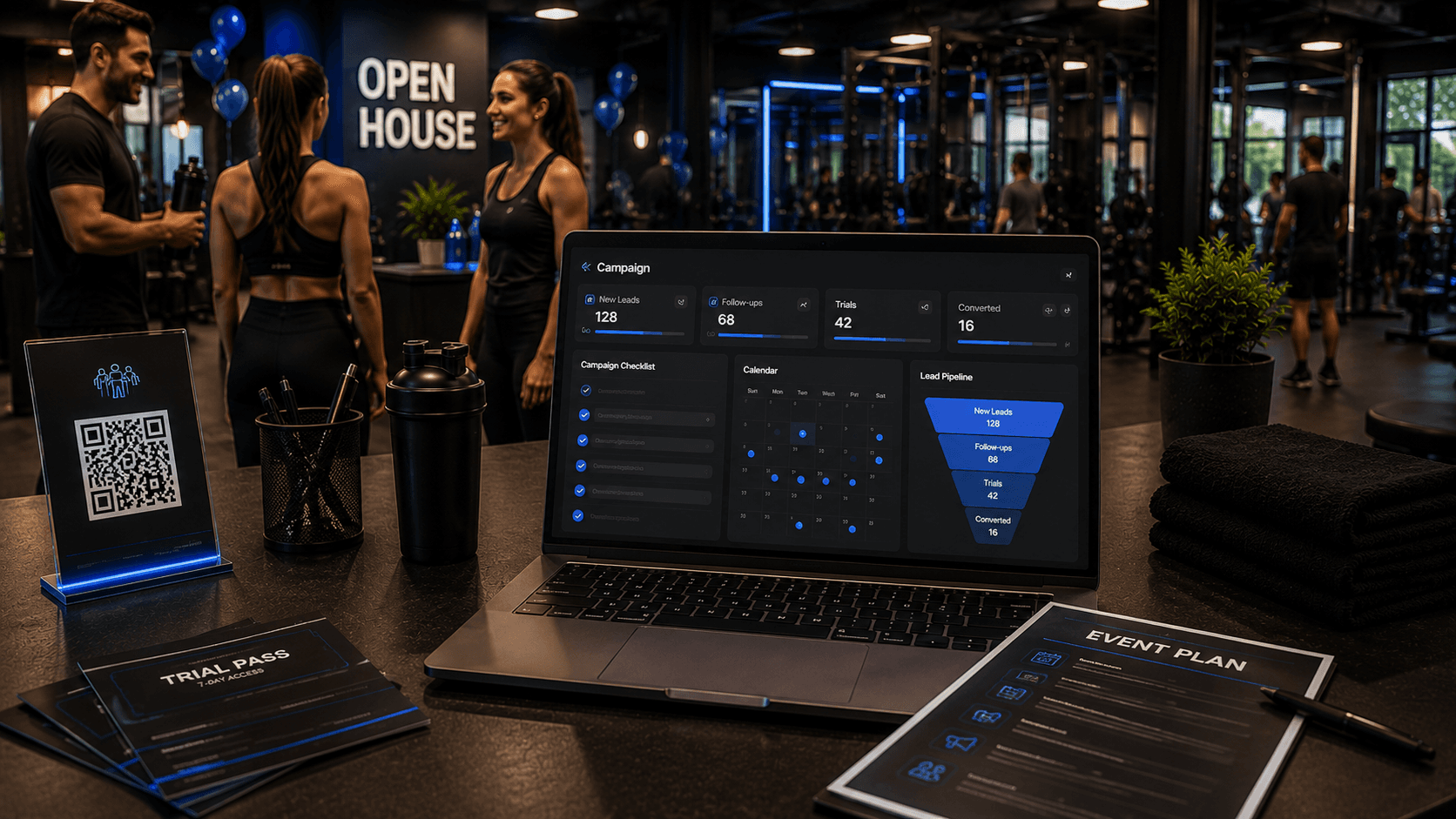
Promotional events work. A well-run transformation challenge can bring in twenty new members in a month. A bring-a-friend day can generate fifty qualified leads in a weekend. But most gyms that run these campaigns end up disappointed — not because the event failed to attract interest, but because the follow-up system collapsed under the volume.
The campaign is the easy part. The follow-up is where revenue is made or lost.
Transformation challenges: structure matters
A transformation challenge — typically a 4-to-12 week program with a defined entry, tracking component, and end result — is one of the highest-converting gym marketing events. It attracts people who are motivated to change but who need a structured entry point.
- Define the challenge clearly: duration, what members commit to, and how results are measured.
- Offer a meaningful prize, but do not make it the whole point. The real prize is the transformation — the material prize just attracts attention.
- Require a registration fee or membership to participate. Free events attract people who are not genuinely committed. A small financial commitment filters for motivation.
- Build in weekly check-ins. These create accountability and give your team regular touchpoints with participants.
- Photograph participants with their consent at the start and end. Before-and-after documentation is both a motivator and your strongest future social proof.
Bring-a-friend days: make the follow-up automatic
Bring-a-friend events are low-cost, high-volume lead generators. The problem is that 50 visitors over a weekend can easily generate 50 untracked contacts that get forgotten by Tuesday.
- Capture contact details at entry — name, phone, and email as a minimum. A simple sign-in form or QR code to a form works.
- Add every new contact to your CRM on the same day, before the weekend is over.
- Assign each lead to a specific admin or trainer who will follow up. Anonymous leads get ignored.
- Follow up within 24 hours with a personalised message, not a mass email. Reference something specific from their visit if possible.
Seasonal offers: timing is everything
New Year, summer, and back-to-school are the three highest-volume windows for gym sign-ups. Running a targeted offer during these periods is not novel — but executing it cleanly is still rare.
- Define your offer clearly. "30% off for new members who join this January" is clear. "Special prices available — ask us" is not.
- Set a hard end date. Urgency without a real deadline is ignored.
- Communicate the offer across every channel — Instagram, WhatsApp status, Google Business Profile, signage inside the gym.
- Have a follow-up sequence ready before the offer launches. Do not build the follow-up pipeline while the campaign is already running.
Open-house events: quality over quantity
An open house — a day or evening where the public is invited to tour your facility, try a class, and meet your team — is an underused format. Unlike digital campaigns, it allows prospective members to experience the gym's atmosphere, which is often the deciding factor.
- Run the event on a day and time when your gym looks and feels its best — ideally during a popular class.
- Have two or three staff members whose only job during the event is to welcome and engage visitors.
- Prepare a simple joining offer that is only available on the day. This closes conversions while motivation is highest.
- Follow up with every attendee who did not sign up within 48 hours.
The follow-up system: build this first
The most important thing to build before any promotional event is not the event itself — it is the workflow that captures and converts the leads it generates.
- Every lead needs to be in one system, accessible to every team member.
- Every lead needs a follow-up task assigned to a specific person, with a specific deadline.
- Follow-up should happen on day 1, day 3, day 7, and day 14. Most conversions from event-generated leads happen within that window.
- After two weeks with no response, leads should move to a lower-priority nurture stage, not be deleted.
A good event without a follow-up system is expensive brand awareness. A decent event with an excellent follow-up system is a revenue driver.